Great Hall, King’s College London, Strand
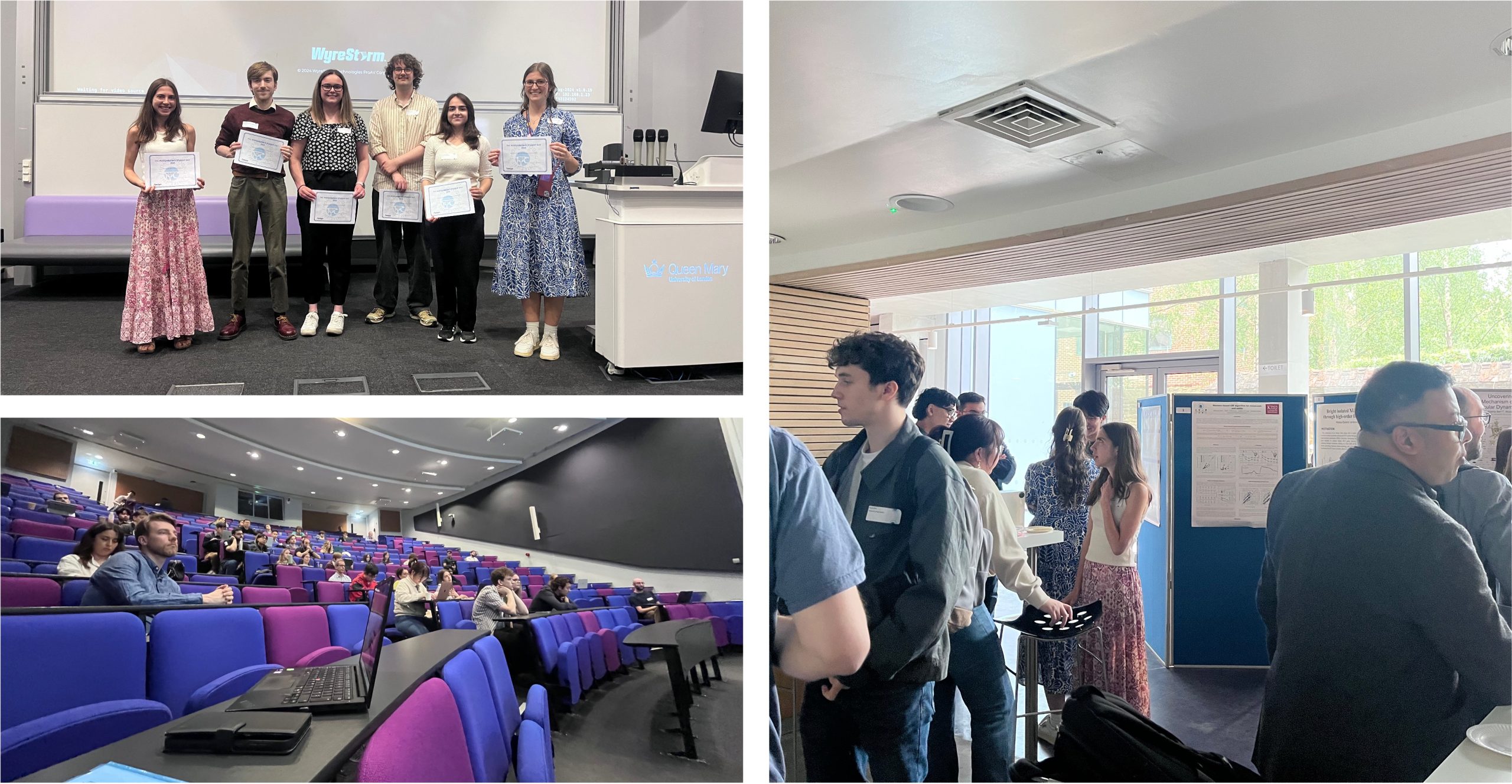
The TYC Student Day is a one‑day celebration showcasing PhD research in the theory and simulation of materials and molecules across the four London Colleges of the Thomas Young Centre (UCL, Imperial, King’s and QMUL), as well as Brunel University London and London South Bank University.
The programme features talks from selected final‑year students, a poster session, and invited guest speakers.
We invite all TYC students to submit abstracts for poster presentations, and final‑year students to submit abstracts for oral presentations. Around 12 talks will be selected (12‑minute presentation + 2‑minute Q&A). All posters from participating institutions will be displayed during the lunchtime poster session and again during the drinks reception at the end of the day.
Cash prizes will be awarded for the Best Talk and Best Poster.
Abstract booklet
Invited speakers:
Emergent Collective Phenomena in Low-Dimensional Materials РGiorgia Fugallo, Ecole Normale Sup̩rieure
CNRS Researcher, Associate Editor for Computational Materials Science, and past winner at the TYC Student Day (circa 2010/11).
Abstract: In low-dimensional materials, reduced dielectric screening, quantum confinement, restricted scattering phase space, and enhanced many-body effects profoundly affect lattice dynamics, electronic excitations, and light–matter interactions, enabling physical regimes that are absent in conventional three-dimensional systems.
In this talk, I will discuss how these effects reshape thermal and optical response in 2D materials, driving the breakdown of conventional bulk descriptions such as Fourier transport and standard three-dimensional exciton models. Particular emphasis will be placed on collective phenomena associated with strong phonon and light–matter interactions, including phonon hydrodynamics and room-temperature second sound, together with exciton and phonon superradiance in the crossover from monolayer to bulk systems, opening new perspectives for nanoscale photonics and energy-efficient thermal management.
Biography: Giorgia Fugallo is a CNRS researcher at the Physics Department of the École Normale Supérieure (ENS) in Paris. She received her PhD in Physics from King’s College London in 2012. Before joining CNRS in 2017, she held postdoctoral positions at Sorbonne University and at the École Polytechnique Fédérale de Lausanne (EPFL), and was awarded the EDF–École Polytechnique Research Fellowship in Renewable Energies.
Her research focuses on first-principles and multiscale modelling of materials for energy applications, with particular emphasis on 2D and van der Waals materials. Her work explores anharmonic effects, thermal transport, and vibrational and electronic spectroscopies, including the development of first-principles methods for phonon transport implemented in the thermal2 package of the open-source Quantum ESPRESSO suite.
She served on the CNRS National Committee, is a member of the steering committee of the European Theoretical Spectroscopy Facility (ETSF), serves as Associate Editor of Computational Materials Science, and was the winner of the TYC Student Day in 2011.
[1] G. Fugallo et al., Nano Lett. 14, 6109 (2014).
[2] A. Cepellotti et al., Nat. Commun. 6, 6400 (2015).
[4] G. Fugallo et al., Phys. Rev. B 98, 184307 (2018).
[4] C. Elias et al., Phys. Rev. Lett. 127, 137401 (2021).
[5] G. Cassabois et al., Phys. Rev. Research 4, L032040 (2022).
[6] G. Cassabois et al., Phys. Rev. X 12, 011057 (2022).
[7] M. Poulos et al. Phys. Rev. B 110, 075434 (2024)
[8] T. Ferre et al. J. Phys. Chem. C 129, 5511 (2025)
Accelerating materials design with AI emulators and generators – Claudio Zeni, Senior Researcher at Microsoft Research Cambridge
Abstract: Materials design is a challenging and time-consuming process that requires exploring a vast and complex chemical space. To accelerate this process, we present MatterSim and MatterGen, two novel models that can emulate and propose novel materials with desired properties.
MatterSim is a machine learning model actively trained from large-scale first-principles computations for efficient atomistic simulations at first-principles level and accurate prediction of materials’ properties across the periodic table and across a wide range of temperatures and pressures.
MatterGen is an atomistic generative model that can propose novel and stable materials across the periodic table. Furthermore, the model can be fine-tuned to conditionally generate stable, novel materials with desired chemistry, symmetry, as well as mechanical, electronic, and magnetic properties.
These models unlock the large-scale discovery, exploration, and simulation of novel crystalline materials under a wide range of thermodynamic conditions, and open new possibilities for computational materials design.
Biography: Claudio Zeni is a senior researcher and project lead at Microsoft Research within the AI for science initiative. He applies AI to materials design and simulation, and is interested in ways to bridge the gap between computational and experimental materials science via AI.
Claudio achieved his Ph.D. in computational physics at Kings’ College London in 2020 and then worked as a researcher at the International School for Advanced Studies in Trieste before joining Microsoft in 2022.