Origin of Trapped Intralayer Wannier and Charge-Transfer Excitons in Moire Materials

When two ultra‑thin semiconductor sheets are stacked with a slight twist, they create a repeating “moiré” pattern similar to the ripples you see when two screens overlap. This pattern changes how the material absorbs light and creates special light‑responsive particles called moiré excitons, made of an electron and the “hole” it leaves behind.
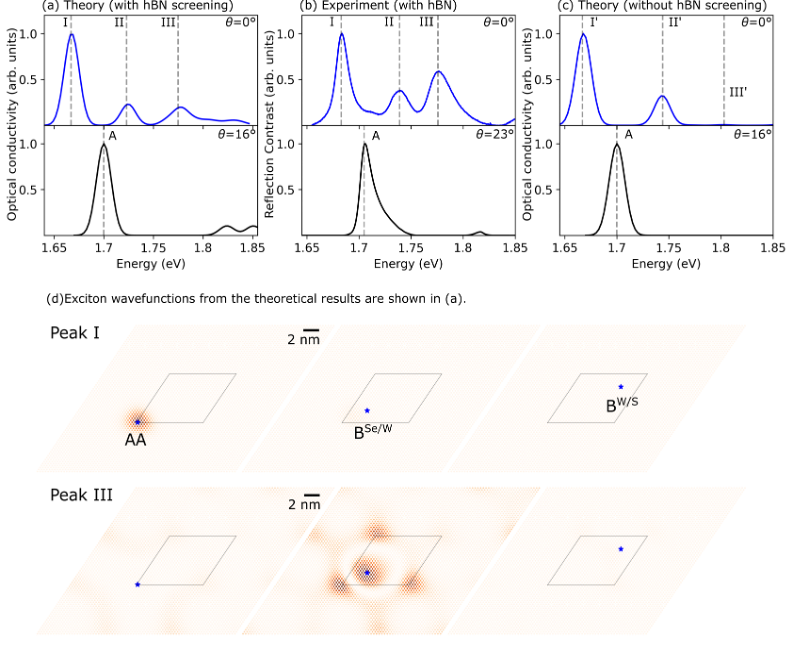
Scientists have known about these excitons since 2019, but it hasn’t been clear why they form or what determines their behavior. In this work, we use detailed quantum‑mechanical calculations to show that two subtle effects are key: tiny atomic shifts within the moiré pattern, and the influence of the surrounding material (like hBN). Together, these effects cause two different kinds of excitons—those where the electron and hole stay close together, and those where they are farther apart—to compete and shape the way the material absorbs light.
This new understanding helps explain all the complex optical features seen in twisted WS₂/WSe₂ layers. More importantly, it offers a roadmap for designing future ultra‑thin optical technologies, from novel light sources to single‑photon devices.
Authors: Indrajit Maity (Newcastle University), Johannes Lischner, Arash Mostofi (Imperial College London), and Ángel Rubio (Max Planck Hamburg / Flatiron Institute).