
Electrically Tunable Friction through Surface Adsorption Layer Restructuring

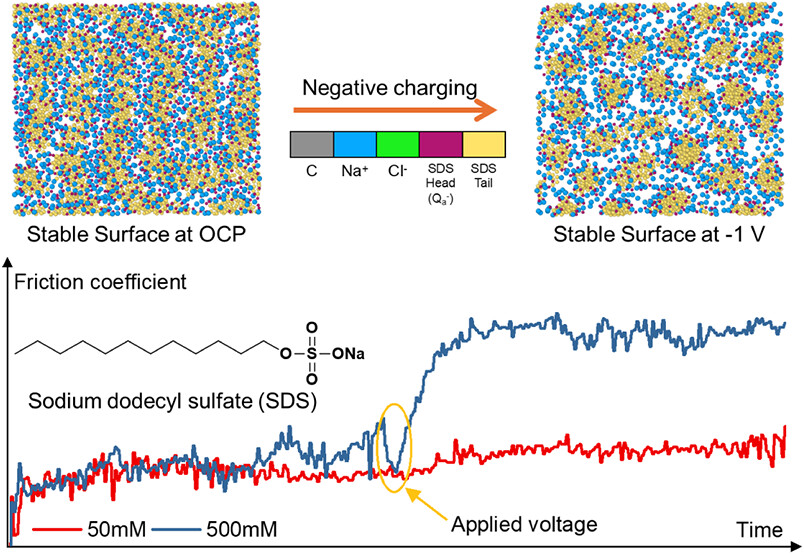
This research reveals that ‘tuning’ friction of surfactant-containing solutions with electricity depends less on the lubricant’s soap-like molecules and more on the sodium ions surrounding them. In a steel-on-steel system, the lubricant molecules naturally form protective, log-shaped ‘rollers’ that keep friction low; however, applying a negative electrical charge pulls sodium toward the surface, causing these rollers to bridge together and ‘scrunch up’ into tiny balls. This structural change breaks the smooth protective layer and increases friction.
Ultimately, the study shows that creating effective ‘smart lubricants’ requires a precise balance of sodium ions and electricity to flip the lubricant’s structure back and forth on command.
Authors: Yun Zhao, Zhaoran Zhu, Jie Zhang, Erik Weiand, Chao Wang, James P. Ewen, Daniele Dini, Hugh A. Spikes, Janet S.S. Wong