April 30, 2026 @ 2:00 pm – 5:00 pm
Venue: UCL Physics A1/3 (top floor), followed by networking in E7 (ground floor)
Zoom login: tyc-administrator@ucl.ac.uk is inviting you to a scheduled Zoom meeting.
https://ucl.zoom.us/j/92446762150
Meeting ID: 924 4676 2150
Join instructions
https://ucl.zoom.us/meetings/92446762150/invitations?signature=0yznmelEUK2woWpuZOo4KbZcrHCo4-Qri8TFZKPQwNo
To Thomas Young Centre runs a continuous programme of Recently Appointed talks to welcome new PIs to the TYC, and to introduce them and their research to the community.
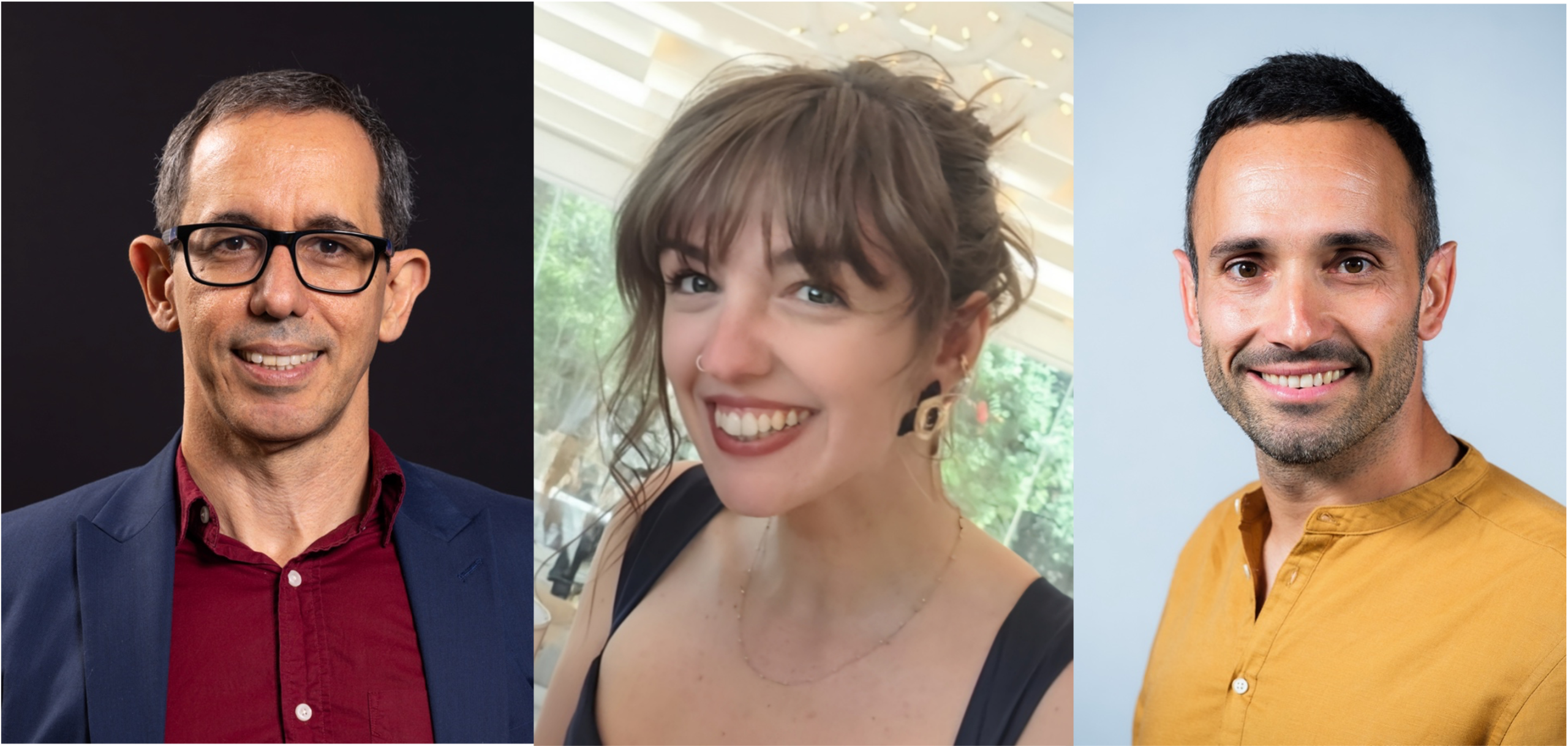
This session introduces Angela Casarella from Imperial, Francisco Martin-Martinez from King’s, and Ricardo Grau-Crespo from QMUL, to the TYC.
Towards a Virtual Laboratory for Clay: from phenomenology to particle-scale modelling – Angela Casarella, Imperial College London
The mechanical behaviour of clay is typically described using macroscopic constitutive models, which are largely phenomenological and do not explicitly account for the underlying particle-scale mechanisms governing deformation and strength. Bridging this gap requires a mechanistic understanding of interactions between individual clay platelets, where anisotropy, electrochemical forces, and pore fluid play a central role.
In this talk, I present a multiscale framework combining coarse-grained molecular dynamics (CGMD) and finite element modelling (FEM). CGMD is used to simulate the collective behaviour of anisotropic clay platelets, while FEM resolves electrochemical interactions and provides particle-to-particle constitutive laws that inform the simulations.
These modelling approaches are supported by synchrotron nano-holo-tomography, enabling 3D imaging of clay particles in their natural saturated state and providing experimental validation of particle geometry, arrangements and spacing.
Together, these developments contribute to a virtual laboratory for clay, enabling a transition from phenomenological descriptions to predictive, physics-based modelling.
Modelling site-disordered solids beyond thermodynamics: DFT, statistical mechanics and machine learning – Ricardo Grau-Crespo, Queen Mary University of London
This talk will present a perspective on the modelling of site disorder in crystalline solids, with emphasis on approaches that go beyond simple energetic descriptions.
I will first outline the main methodological landscape for treating site disorder, from mean-field and cluster-expansion strategies to explicit configurational and ensemble-based approaches. I will then focus on symmetry-adapted ensemble models [1], which make it possible to combine statistical mechanics with atomistic calculations such as DFT in order to predict not only configurational thermodynamics, but also properties that are often difficult to capture with conventional cluster expansions, including cell parameters, effective physical properties and average spectra (such as NMR [2, 3]). Examples will be used to illustrate how ensemble models can provide a realistic description of disordered materials when local geometry, long-range interactions, or property averaging are essential.
Finally, I will discuss recent work on generative AI for crystal structures through the CrystaLLM project [4], and a possible route to address one of its current limitations: the treatment of site disorder. I will introduce the idea of a crystal virtualiser that maps explicit ordered supercells back to virtual disordered representations with fractional occupancies, enabling a posteriori correction of AI-generated crystal structures.
[1] Site-Occupancy Disorder (SOD) repository: https://github.com/rgraucrespo/sod
[2] R Grau-Crespo, S Hamad, SRG Balestra, R Issa, TD Sparks, A Fernandes, BL Griffiths, R Moran, D McKay, SE Ashbrook. Capturing local compositional fluctuations in NMR modelling of solid solutions. Chemical Science 16 (2025) 19357-19369.
[3] RF Moran, D McKay, PC Tornstrom, A Aziz, A Fernandes, R Grau-Crespo, SE Ashbrook. Ensemble-Based Modeling of the NMR Spectra of Solid Solutions: Cation Disorder in Y2(Sn,Ti)2O7. Journal of the American Chemical Society 141 (2019) 17838-17846.
[4] LM Antunes, KT Butler, R Grau-Crespo. Crystal structure generation with autoregressive large language modeling. Nature Communications 15 (2024) 10570.
Computational modelling of nature-inspired bio-based materials – Francisco Martin-Martinez, King’s College London
Valorising extensively available biomass wastes, developing biobased materials, and mimicking nature in its ability to design materials for circularity as well as performance are some of the avenues to achieve a more sustainable development. In our lab, we seek material building blocks in biomass waste and non-critical material sources, and we investigate structure-property relationships, assembly, and degradation mechanisms of biomolecules and biomass materials. We use computational chemistry, atomistic modelling, and machine learning to develop molecules and materials with applications in precision agriculture, self-healing infrastructure, or energy storage.
 Google Calendar
  iCalendar