
- This event has passed.
1st TYC Annual Lecture: Photon-Mediated Interactions and Quantum Material Control via QEDFT, Prof. Angel Rubio
26 March 2026 @ 4:00 pm – 6:00 pm
Join us for a special lecture in G20, Royal School of Mines followed by a drinks reception in G01.
This is also a hybrid event. For those who cannot attend in person you can join online via link.
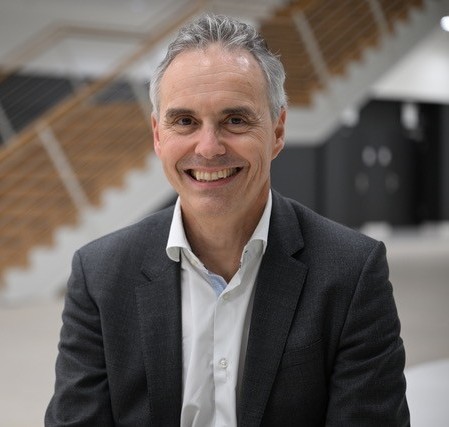
Dr Angel Rubio, Max Planck Institute for the Structure and Dynamics of Matter & Initiative for Computational Catalysis (ICC) and Center for Computational Quantum Physics (CCQ) Flatiron Institute
Prof. Angel Rubio received his PhD in Physics with honors from the University of Valladolid in 1991 where he did fundamental work on the structural and optical properties of metallic clusters. Then moved to a postdoctoral position at UC Berkeley-Physics (92-95) where he predicted a new type of boron-nitride nanotubes (PRB1994) triggering their ensuing experimental synthesis. Between 1994 and 2001 as Professor at UVA he started the ab initio materials research open-source project octopus used now by over 1000 groups worldwide. Diverse Professorships at École Polytechnique Paris, FU Berlin and Montpellier followed. In 2001 he moved as Chair of Condensed Matter Physics at UPV/EHU. There he engaged in highly successful work on modeling of excited-state properties of materials and nanostructures setting the foundations of modern theoretical spectroscopy (RMP2002). In August 2014 he accepted the position as Max Planck Director. There he has pioneered the development of quantum electrodynamical density functional theory (QEDFT), a novel theoretical framework for strong light-matter phenomena in chemistry and materials sciences (PNAS2015, Nat.Rev.Chem.2018). His work has been recognized by several awards, including the 2023 Spanish National Physics Prize “Blas Cabrera” 2018 Max Born medal and prize, 2016 Medal of the Spanish Royal Physical Society and the 2014 Premio Rey Jaime I for basic research, and more, and elected member of different academies, including the German Leopoldina Academy and Berlin-Brandenburgischen Akademie der Wissenschaften, the European Academy of Sciences, the Academia Europaea, and a foreign associate member of the National Academy of Sciences (USA).
Title: Photon-Mediated Interactions and Quantum Material Control via QEDFT
Abstract: The quantum vacuum is not empty: confined electromagnetic modes in cavities can mediate interactions that reshape material ground states. Embedding Cavity materials engineering is an emerging field at the intersection of quantum optics and condensed matter physics, where the quantum vacuum fluctuations of confined electromagnetic fields can be harnessed to control and design material properties at equilibrium. Embedding quantum materials inside optical or microwave cavities enhances light–matter coupling to the point where even the vacuum field can induce macroscopic changes—such as shifts in superconductivity, magnetism, Dirac gaps, Fermi velocity, or interlayer spacing—without any external driving or photon excitation. This “dark” regime fundamentally differs from traditional light-driven approaches and opens a new route for modifying the ground state of matter.
Describing these effects requires theoretical frameworks that go beyond standard electronic structure methods. Quantum Electrodynamical Density Functional Theory (QEDFT) incorporates quantized photon fields directly into ab initio simulations, providing a first-principles platform to predict cavity-induced modifications of electronic, magnetic, and structural properties. Complementary Hartree–Fock and many-body approaches reveal how photon-mediated interactions, including anisotropic mode effects, can control correlations and optical responses in two-dimensional and van der Waals materials.
In this talk, I will present the principles of QEDFT, highlight recent experimental and theoretical breakthroughs in cavity-engineered quantum materials, and discuss emerging opportunities where vacuum fluctuations, rather than classical light, become a new tool for controlling correlated quantum phases.
 Google Calendar
  iCalendar