Modifying polyelectrolyte charge density and surface coverage for enhanced polyelectrolyte-surfactant lubrication of biomimetic interfaces

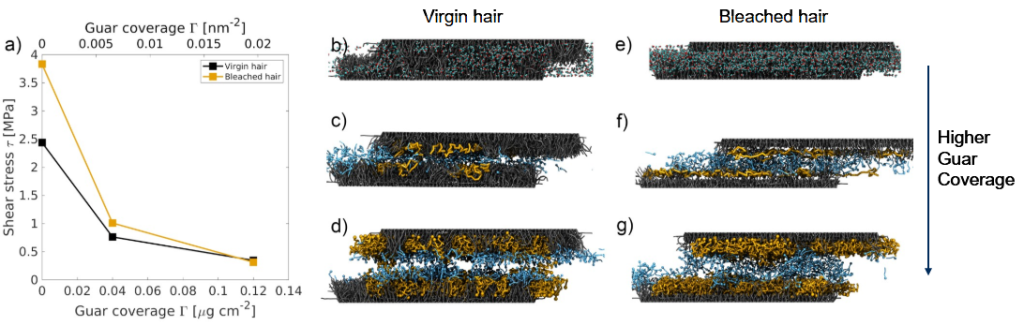
Hair care products like shampoos and conditioners work by depositing charged polymers and surfactants onto hair to make it feel smooth and reduce friction, but exactly how these ingredients need to be designed for best performance hasn’t been fully understood. This study used computer simulations (coarse-grained molecular dynamics) to test how a plant-based conditioning polymer called cationic guar performs when combined with a common cleansing surfactant (sodium dodecyl sulfate) on model surfaces representing both healthy and bleach-damaged hair. Two properties of the guar gum were varied: how densely it was electrically charged, and how much of it was deposited on the hair surface. It was found that more highly charged guar, and guar applied more densely, both reduced friction better, mainly because they helped trap more surfactant and water at the hair surface, pushing the two hair strands further apart. Once the polymer’s surface coverage was high enough, this friction-reducing benefit remained strong even on badly damaged hair, whereas weakly charged, sparsely applied guar gum could barely improve on the damaged hair’s already-poor lubrication. Interestingly, the polymer’s shape on the surface (lying flat versus forming loops) mattered much less than expected; the key factor was simply how much lubricating water and surfactant got locked into the film. These findings could help cosmetic chemists fine-tune plant-derived polymers to make more effective, sustainable hair care formulations.
Authors: Erik Weiand, Dr. Francisco Rodriguez-Ropero, Dr. Stefano Angioletti-Uberti, Prof. Daniele Dini, and Dr. James P. Ewen