
On the role of crack electrolyte wetting in the degradation and performance of battery active particles

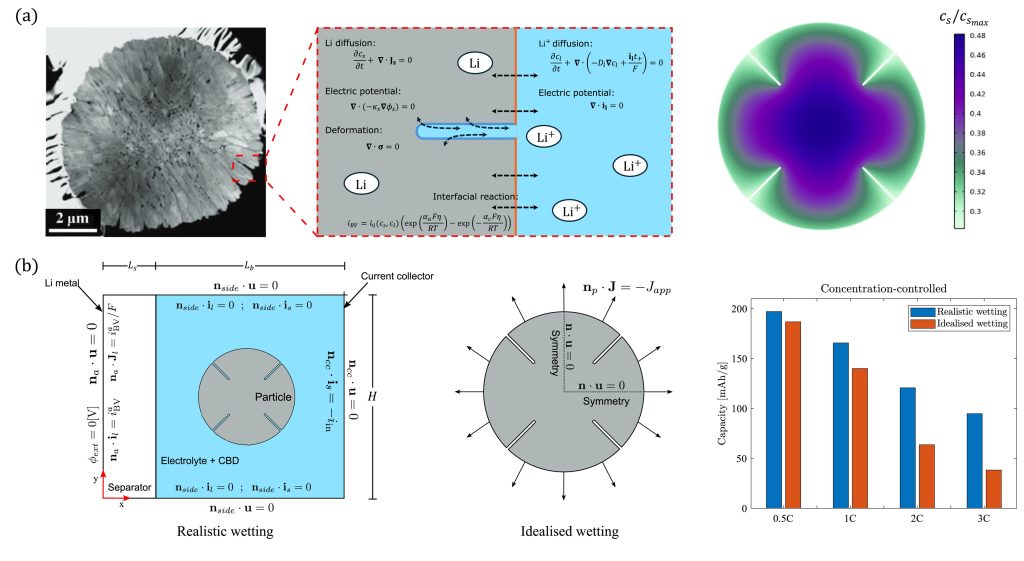
The paper shows that cracks in lithium-ion battery cathode particles are not only damage features but also new electrochemical pathways: once electrolyte enters these cracks, lithium can move and react on internal crack surfaces rather than only on the outer particle surface. A detailed physics-based model that explicitly includes electrolyte inside and outside cracks is compared with a simpler model that assumes lithium leaves or enters the particle uniformly everywhere, as adopted in the literature so far.
We find that the simpler assumption misses important local effects: reactions concentrate strongly near crack tips, where lithium flux can become about eight times larger than the imposed uniform value. This redistribution is driven mainly by the lithium concentration and stress state inside the solid particle, while voltage changes in the electrolyte inside the crack are comparatively small.
As a result, conventional uniform-flux models can substantially underestimate how much capacity a cracked particle can deliver and how much mechanical stress it experiences; at 1C they underpredict capacity by about 25% and tensile stresses by roughly 10%. Electrolyte wetting of cracks must be included to predict battery performance and degradation reliably, as it changes both lithium utilisation and the stress histories that drive further cracking.
Authors: Sebastian Luza-Vega, Ying Zhao, Emilio Martínez-Pañeda