
Phospholipid Saturation Modulates Cholesterol Partitioning and Heat Transport in Lipid Bilayers under Thermal Gradients

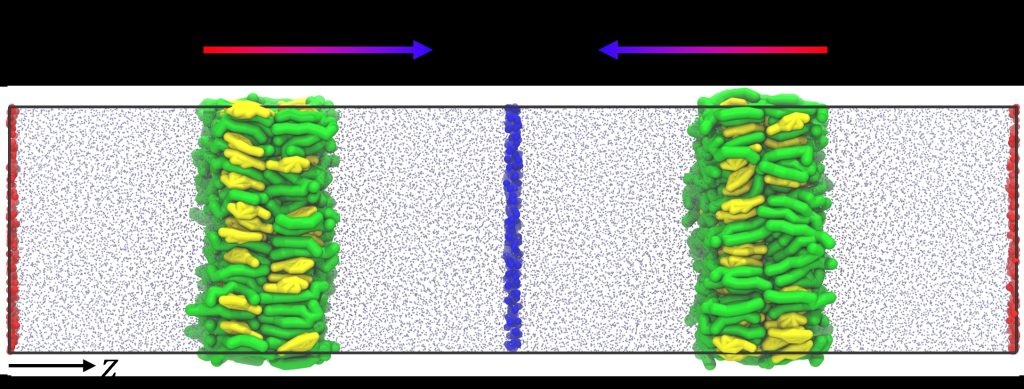
How do cell membranes respond to heat? Cell membranes are not passive barriers; they are dynamic, organised structures whose composition can change in response to their environment.
In our study, we used molecular simulations to explore how cholesterol moves within membranes when one side is warmer than the other, a situation relevant to natural heat production in cells and to thermal therapies for cancer. We found that cholesterol moves away from hotter regions and accumulates in colder parts of the membrane. This heat-driven redistribution depends on membrane composition: more saturated lipids amplify the effect, allowing heat to travel more efficiently across the membrane.
These findings help us understand how local temperature changes can influence membrane organisation, with potential implications for cell biology, drug delivery and nanomaterial-based heat therapies.
Authors: Zhibo Deng, Mona W. Qiu, Fionn Carman, John M. Seddon, Fernando Bresme