
Structure–Property Relationships of Near-Infrared Cyanine Dyes: Chalcogen-Driven Singlet Oxygen Generation with High Fluorescence Efficiency

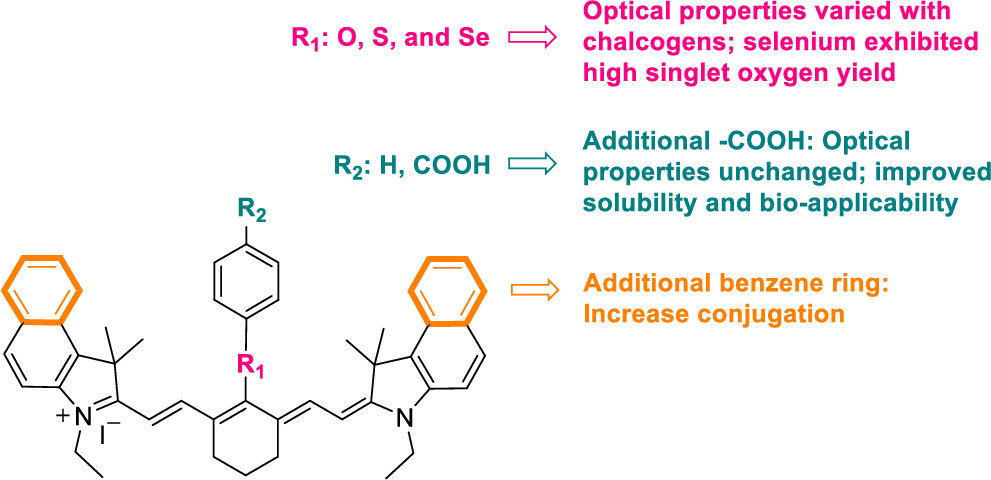
We developed and studied eight new dyes that absorb and emit light in the near-infrared region, which is invisible to the human eye but very useful in medical and imaging applications.
By changing one key atom in the dye structure – oxygen, sulphur, or selenium, we were able to fine-tune how the dyes behave. All of the dyes absorbed and emitted near-infrared light very strongly, and theoretical calculations helped confirm and explain these results. The dyes were also very bright, meaning they absorbed light efficiently and gave off a strong signal. Notably, the dyes containing selenium were especially effective at producing singlet oxygen, a reactive form of oxygen used in certain light-based therapies.
This strong performance makes these dyes promising candidates for deep near-infrared imaging and light-activated medical treatments.
Authors: Shufan Yang, Ewan Forsyth, Wuyang Lin, Kerry Setchfield, Rachel Crespo-Otero,
Devis Di Tommaso, Annamaria Lilienkampf, Amanda Wright, Mark Bradley