
Transiently delocalised hybrid quantum states are gateways for efficient exciton dissociation at organic donor-acceptor interfaces

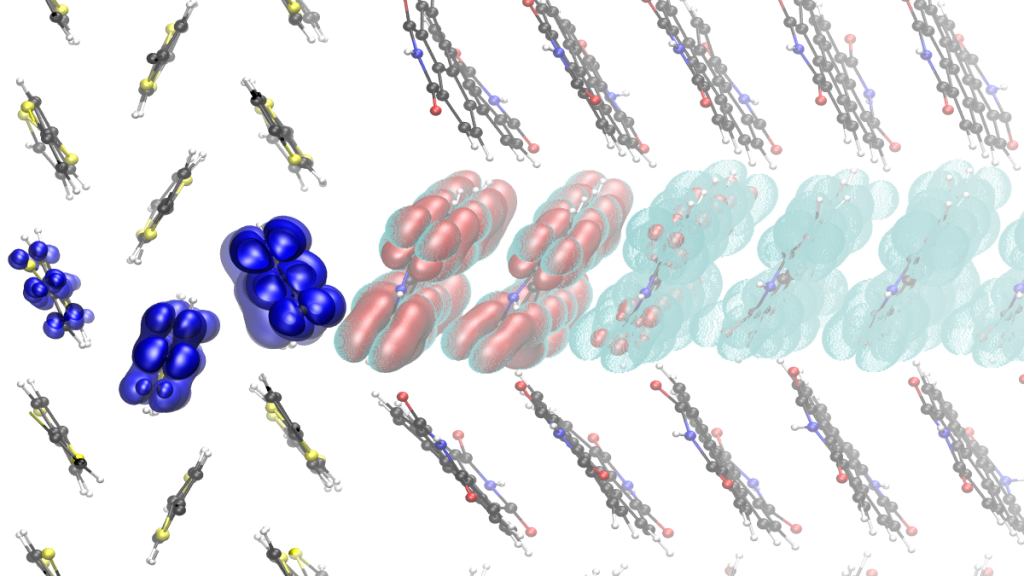
Organic solar cells have been at the centre of research attention in recent decades due to their ease of processing and dramatic rise in efficiency. However, the exact mechanism by which these devices absorb sunlight and convert this energy into a current remains without scientific consensus.
Here, we report the development and application of X-SH, a quantum dynamics program that is able to simulate the process of light-induced charge generation and provide insight on a molecular scale – something experiments are hard-pressed to do. We apply X-SH to elucidate the mechanism of charge generation in a realistic device interface, and find that significant increases in device efficiency can be achieved by tuning the microscopic characteristics of the interface to a realistic extent.
Authors: Filip Ivanović, Samuele Giannini, Wei-Tao Peng & Jochen Blumberger
DOI: https://doi.org/10.1038/s41467-025-67722-4