1 June 2026 @ 1:30 pm – 3 June 2026 @ 4:30 pm
Venue: The Great Hall, King’s College London, Strand
Materials for energy harvesting are pivotal to global decarbonisation efforts and the prevention of climate breakdown. This workshop will focus on photovoltaic and thermoelectric materials, which generate electricity from solar energy and waste heat, respectively. While both technologies are relatively mature and commercially available, their adoption and the breadth of their applications could increase significantly if the efficiency of their energy conversion processes were substantially improved.
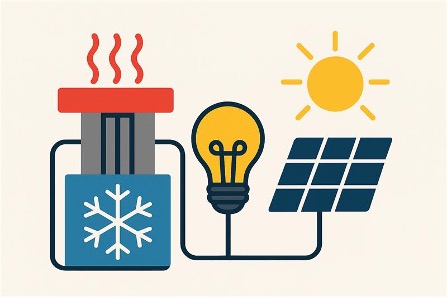
Achieving such improvements requires a deeper understanding of the fundamental interactions that govern material properties, including electron-phonon and electron-electron interactions, as well as interactions with defects and external perturbations such as light. Recent advances in modelling techniques have enabled unprecedented insight into these processes. The workshop will bring together leading experts in these areas to discuss recent breakthroughs and identify new directions for dramatically enhancing the performance of thermoelectric and photovoltaic materials.
Photovoltaic and thermoelectric technologies often rely on similar classes of materials, including inorganic bulk compounds and their nanostructured forms, and more recently, two-dimensional, organic, and hybrid materials. In photovoltaics, the operation is typically governed by electron-phonon, electron-electron, and electron-defect interactions, alongside coupling with photons. In thermoelectrics, phonon-phonon and electron-phonon interactions are considered central, together with phonon-defect and electron-defect interactions. Therefore, electron-phonon and electron-defect interactions are of significant interest to both communities.
However, emerging research has revealed a deeper set of commonalities between photovoltaics and thermoelectrics. For instance, electron-electron interactions play a crucial role in accurately modelling electron-phonon interactions in narrow-bandgap and intermetallic thermoelectric materials. In halide perovskites, strong phonon-phonon interactions can significantly influence photovoltaic performance. Similarly, plasmons, typically employed to enhance solar absorption in metallic nanostructures, may also benefit thermoelectric materials with high doping levels. Finally, polarons – quasiparticles formed by electrons interacting strongly with lattice vibrations are increasingly recognised as relevant to both fields, particularly in oxides, organic and two-dimensional materials.
This workshop will highlight recent advances in theoretical and computational methods used to characterise the interactions in realistic materials. Several invited talks will also explore the application of modern AI and machine learning techniques for the discovery of novel photovoltaic and thermoelectric materials. Approximately half of the invited presentations will focus on experimental research, including the synthesis of new materials and the characterisation of key interaction mechanisms. Together, these contributions aim to identify the most pressing challenges in designing next-generation materials with significantly improved energy conversion efficiencies.
Workshop Programme
Registration
Register for the workshop here:
The registration deadline is 5 May 2026
If you are attempting to register from a medical, educational or governmental institution whether working onsite, or remotely from home, a firewall may prevent you from making the booking. You will therefore need to use another internet connection. You should also use either a laptop or PC to make the booking, and not iPhone or tablet, and either Firefox or Microsoft Edge rather than Google Chrome.
Abstract submission
In addition to invited talk, we offer participants the opportunity to present their work through contributed talks (15 minutes + 5 minutes Q&A) and posters.
The deadline for applications for contributed talks has been extended to 22 April 2026.
The deadline for poster abstracts is 1 May 2026.
We may be able to provide some financial assistance for delegates who experience financial strain byregistering for this workshop. Please send an email to the organising committee at tyc-administrator@ucl.ac.uk justifying your reason for applying for support to attend the meeting.
Invited speakers
Dr. Keith Butler, University College London, UK
Prof. Emiliano Cortes, Ludwig Maximilian University of Munich, Germany
Dr. Jennifer Coulter, Flatiron Institute, USA
Prof. Janine George, Friedrich Schiller University of Jena, Germany
Dr. Samuele Giannini, CNR Pisa, Italy
Prof. Feliciano Giustino, University of Texas Austin, USA
Prof. Maria Ibanez, Institute of Science and Technology, Austria
Prof. Jenny Nelson, Imperial College London, UK
Prof. Neophytos Neophytou, University of Warwick, UK
Prof. Andrej Pustogow, Technical University of Vienna, Austria
Prof. Sivan Refaeli-Abramson, Weizman Institute of Science, Israel
Prof. Henning Sirringhaus, University of Cambridge, UK
Prof. Kevin Sivula, Ecole Polytechnique Federale de Lausanne, Switzerland
Prof. G. Jeffrey Snyder, Northwestern University, USA
Dr. Terumasa Tadano, National Institute for Materials Science, Japan
Prof. Matthieu Verstraete, University of Utrecht, Netherlands
Sponsors
Generously sponsored by Psi-K, CCP9 and CECAM JC Maxwell
Contact
Ivana Savic – ivana.savic@kings.ac.uk
Organisers:
Jochen Blumberger – University College London
Alex Ganose – Imperial College London
Johannes Lischner – Imperial College London
Amel Mazari – Imperial College London
Ivana Savic – King’s College London
Alex Shluger – University College London
Karen Stoneham – University College London
Jan Tomczak – King’s College London
Martijn Zwijnenburg – University College London
By registering for this conference, you agree to our code of conduct for the event.
Code of Conduct
We value the participation of every member of the materials and molecular modelling community and want to ensure that everyone has an enjoyable and fulfilling experience, both professionally and personally. Accordingly, all participants of the 8th Energy Materials Workshop are expected to always show respect and courtesy to others. The TYC and its partners strive to maintain inclusivity in all of our activities. All participants (staff and students) are entitled to a harassment-free experience, regardless of gender identity and expression, sexual orientation, disability, physical appearance, body size, race, age, and/or religion. Harassment in any form is not acceptable for any of us. We respectfully ask all attendees of the 8th Energy Workshop to kindly conform to the following Code of Conduct:
- Treat all individuals with courtesy and respect.
- Be kind to others and do not insult or put down other members.
- Behave professionally. Remember that harassment and sexist, racist, or exclusionary jokes are not appropriate.
- Harassment includes, but is not limited to, offensive verbal comments related to gender, sexual orientation, disability, physical appearance, body size, race, religion, sexual images in public spaces, deliberate intimidation, stalking, following, harassing photography or recording, sustained disruption of discussions, and unwelcome sexual attention.
- Participants asked to stop any harassing behaviour are expected to comply immediately.
- Contribute to communications with a constructive, positive approach.
- Be mindful of talking over others during presentations and discussion and be willing to hear out the ideas of others.
- All communication should be appropriate for a professional audience, and be considerate of people from different cultural backgrounds. Sexual language and imagery are not appropriate at any time.
- Challenge behaviour, action and words that do not support the promotion of equality and diversity.
- Arrive at the conference events punctually where possible.
- Show consideration for the welfare of your friends and peers and, if appropriate, provide advice on seeking help.
- Seek help for yourself when you need it.
Your data
Thank you for your interest in attending this workshop. Any information collected from you will be used to help us to organise the event, and to contact you with details relevant to the event only.
 Google Calendar
  iCalendar